
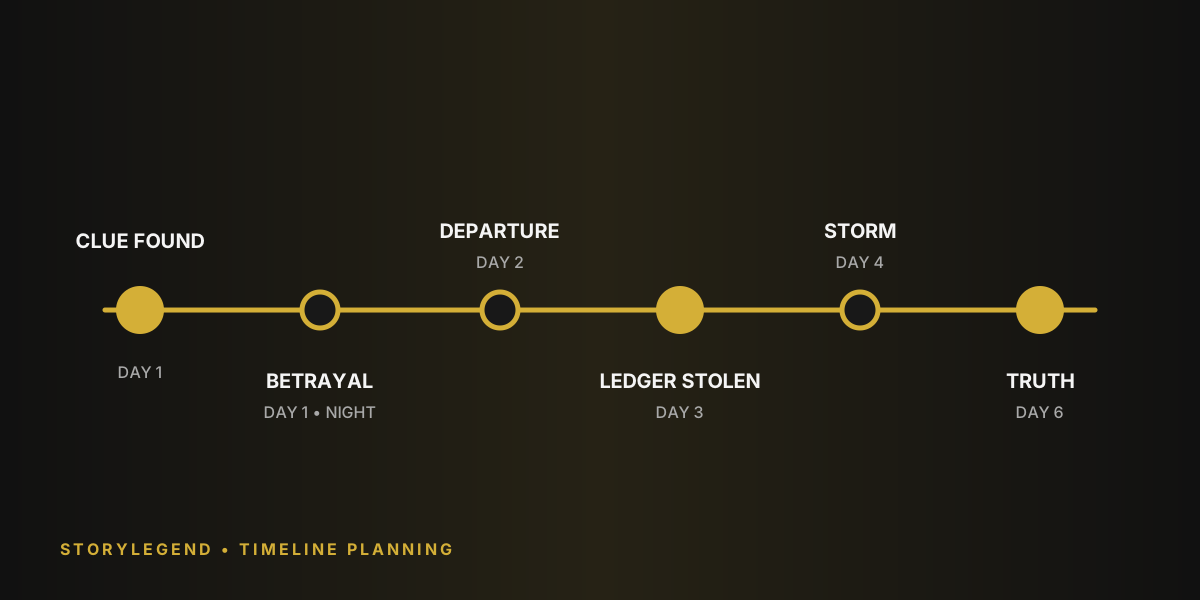
A story timeline is not a decorative spreadsheet you make after the interesting work is done. It can work as a model of cause and effect: what happens, when it happens, who knows about it, and what becomes possible next. When that model is clear, you can revise a complicated draft without accidentally giving a character knowledge they have not earned or asking them to cross a continent overnight.
The useful version does not need every breakfast and doorway. It needs the events that change the story. The template below is intentionally simple enough to begin today and flexible enough to support mysteries, romances, epic fantasy, historical fiction, and multi-POV novels.
One guiding principle: timeline entries tend to be most useful when they explain a change. If nothing changes in the plot, character, information, location, or pressure, the moment may belong in your scene notes rather than your master timeline.
The story timeline template
Create one row per meaningful event. You can use a document, cards, or the StoryLegend Timeline Creator. Start with certainty, not detail: add the fixed events first, then place flexible scenes around them.
| Field | What to record | Why it matters |
|---|---|---|
| Date / story time | Exact date, relative day, season, or “three hours after the breach.” | Establishes order and duration. |
| Event | The specific action or change that affects the story. | Keeps entries active and testable. |
| Characters / POV | Who participates, witnesses, or narrates. | Exposes impossible overlaps and missing reactions. |
| Location | Where the event occurs, plus origin or destination for travel. | Reveals travel-time problems. |
| Plotline tag | Main plot, romance, investigation, antagonist, family, and so on. | Lets you isolate and inspect one thread. |
| Knowledge gained | What becomes known, and by whom. | Prevents premature knowledge. |
| Consequence | The next decision, obstacle, deadline, or emotional shift. | Protects cause-and-effect logic. |
| Status / certainty | Fixed, flexible, implied, backstory, or draft. | Shows what can safely move during revision. |
A six-pass approach to building the timeline
Choose your clock
Decide whether the novel uses calendar dates, numbered story days, ages, seasons, or time relative to a defining event. Consider the smallest unit that affects the plot. A multi-generational story may need weeks or years; a tense confrontation may need minutes.
Anchor the immovable events
Add births, festivals, eclipses, deadlines, battles, departures, discoveries, and any event named with a fixed date. These anchors form the frame. Consider marking them “fixed” so they are less likely to shift during a later rewrite.
Add each plotline separately
Enter the protagonist’s external goal, internal arc, relationship thread, antagonist plan, and relevant backstory as distinct tracks or tags. There is no need to force them into perfect alternation yet. It can help to make each thread logical on its own first.
Connect causes to consequences
For every major event, ask: what made this happen, and what must happen because of it? If the answers are missing, you may have a coincidence, a stalled thread, or a scene that looks dramatic but does no structural work.
Account for time off-page
Add travel, recovery, research, message delivery, preparation, and waiting. These intervals are where many continuity errors hide. You need not dramatize them, but it helps if your timeline allows them to exist.
Stress-test the draft
Filter by character, location, or plotline. Check who is where, what each person knows, and whether emotional reactions have enough room. Then compare the timeline against chapter order, because narrative order and chronological order are not always the same.
Keep chronology and chapter order distinct
A nonlinear novel still needs a reliable chronology. Record when an event actually occurs, then separately note where the reader encounters it. A murder may happen on Day 0, appear as a false account in Chapter 4, and be shown accurately in Chapter 22. Those are three narrative moments tied to one chronological event.
For flashbacks, record the historical event as backstory and tag any present-day scene that reveals it. This lets you inspect two different questions: “Does the history make sense?” and “Does the reader learn it at the right pace?” StoryLegend’s events, tags and filters, and multiple timeline views can help you move between those perspectives without flattening them into one list.
A practical continuity review
- Presence: Is every character physically able to attend each event?
- Travel: Is there enough time for the route, weather, rest, and transportation?
- Knowledge: Has each character witnessed, inferred, or been told what they act upon?
- Recovery: Do injuries, grief, exhaustion, and repaired objects persist believably?
- Deadlines: Do countdowns decrease consistently in dialogue and narration?
- Sequence: Does every consequence follow its cause, even when chapters reveal them out of order?
- Thread rhythm: Has an important subplot disappeared for so long that its return feels disconnected?
Consider doing this review after structural changes, not only before publication. Moving one reveal can alter motive, knowledge, and emotional logic across several chapters. If you use continuity checks in the Timeline Creator, treat the results as prompts to investigate—not substitutes for your judgment about the story.
What not to put in the master timeline
A timeline becomes difficult to use when it duplicates the manuscript. Keep line-level dialogue, full scene summaries, sensory detail, and exploratory prose in your outline or scene notes. The Writing Studio can hold outlines, scenes, chapters, and beats, while a Story Codex can organize story reference material. The timeline can answer “when and because of what?” while the draft answers “what is it like to be there?”
There is one exception: include a small detail when its state changes over time. A broken watch, an inherited ring, or a coded letter deserves an event if its location or ownership drives later action.
Give your story a timeline you can trust
Build your fixed events first, add plotline tags, and inspect the story from multiple views. StoryLegend’s Timeline Creator supports fictional calendars, continuity checks, filters, and exports when you are ready to move beyond a static template.
Build your story timelineFrequently asked questions
When should I create a story timeline?
Start when sequence or duration begins affecting your decisions. Planners may build one before outlining; discovery writers can reconstruct one after a first draft. Update it whenever a revision changes a major event, reveal, journey, or deadline.
How detailed should a fiction timeline be?
Detailed enough to test the logic, but not so detailed that it becomes another manuscript. Track changes in plot, character, knowledge, location, condition, and pressure. Use hours only when hours matter; otherwise days, weeks, or seasons may be clearer.
Can I use this template for multiple POV characters?
Yes. Add the POV and participating characters to each event, then filter or review one character at a time. Also compare tracks side by side where their actions interact.
What if my fictional world has its own custom calendar?
Define its units, month or season lengths, leap rules, and repeating observances before assigning dates. A fictional calendar still needs consistent durations and conversion rules, especially if characters use more than one system.